


























Decentralized Finance (DeFi)
The financial world has changed dramatically over the past decade, and one of the biggest innovations to emerge from blockchain technology is Decentralized Finance, commonly known as DeFi. Unlike traditional banking systems that rely on centralized institutions, DeFi enables users to access financial services directly through blockchain-based applications.
From lending and borrowing to trading and earning passive income, DeFi has created an entirely new financial ecosystem that operates without banks or intermediaries. While it offers exciting opportunities, it also comes with unique risks that every investor should understand.
This guide explains what DeFi is, how it works, its benefits, challenges, and why it has become one of the most important sectors in the cryptocurrency industry.
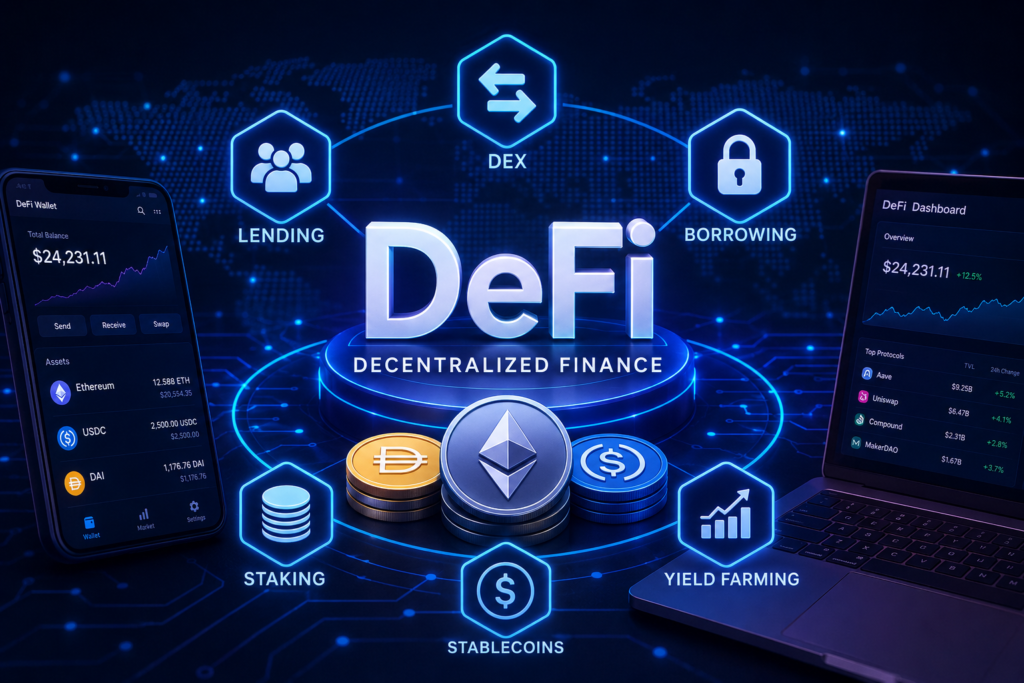
What Is DeFi?
Decentralized Finance refers to a collection of financial applications built on blockchain networks that allow users to perform financial transactions without relying on centralized organizations.
Instead of trusting banks or payment providers, users interact with smart contracts—self-executing pieces of code that automatically perform transactions when predefined conditions are met.
Most DeFi applications are built on Ethereum, although other blockchain networks like BNB Chain, Solana, Avalanche, and Arbitrum have also become popular ecosystems.
How DeFi Works
Traditional finance requires intermediaries to verify transactions, store assets, approve loans, and process payments.
DeFi replaces these intermediaries with blockchain technology.
The basic components include:
- Blockchain network
- Smart contracts
- Cryptocurrency wallets
- Decentralized applications (DApps)
- Digital assets and tokens
Users connect their wallets directly to applications and maintain complete control over their funds throughout the process.
Why DeFi Has Become Popular
Several factors have contributed to the rapid growth of decentralized finance.
Full Control Over Assets
Unlike traditional banks, users always control their private keys and funds.
Global Accessibility
Anyone with an internet connection can participate without needing approval from financial institutions.
Transparency
All transactions are recorded on public blockchains where anyone can verify activity.
Lower Fees
Removing intermediaries often reduces transaction costs.
Continuous Availability
Most DeFi platforms operate 24 hours a day without holidays or business hours.
Common DeFi Services
Decentralized Exchanges (DEXs)
DEXs allow users to trade cryptocurrencies directly from their wallets without transferring funds to centralized exchanges.
Popular examples include:
- Uniswap
- PancakeSwap
- Curve
- SushiSwap
These exchanges use liquidity pools instead of traditional order books.
Lending Platforms
Users can lend cryptocurrencies to others and earn interest.
Borrowers deposit collateral before receiving loans, reducing default risks.
Examples include:
- Aave
- Compound
- Spark
Borrowing
Instead of selling crypto holdings, investors can borrow stablecoins using their digital assets as collateral.
This allows investors to maintain exposure to long-term price appreciation.
Stablecoins
Stablecoins are cryptocurrencies designed to maintain stable values.
Popular examples include:
- USDT
- USDC
- DAI
Stablecoins serve as the foundation for many DeFi applications.
Yield Farming
Yield farming involves moving assets between liquidity pools to maximize rewards.
Investors earn returns through:
- Trading fees
- Platform incentives
- Governance token rewards
Although profitable during certain market conditions, yield farming also carries significant risks.
Staking
Some DeFi protocols allow users to stake tokens and receive rewards while helping secure blockchain networks.
Staking generally provides a more predictable return than yield farming.
Understanding Smart Contracts
Smart contracts are the backbone of decentralized finance.
These automated programs execute financial agreements without requiring human intervention.
For example:
- Loan repayments
- Interest distribution
- Token swaps
- Liquidity rewards
Once deployed, properly audited smart contracts reduce the need for trusted intermediaries.
Advantages of DeFi
Financial Inclusion
Millions of people worldwide lack access to traditional banking services.
DeFi provides financial tools regardless of geographical location.
Transparency
Every transaction can be verified on the blockchain.
Faster Transactions
Cross-border transfers can often settle within minutes instead of days.
Innovation
Developers continuously create new financial products that would be difficult to build in traditional banking.
Ownership
Users maintain complete ownership of their digital assets.
Risks of DeFi
Despite its benefits, DeFi is not risk-free.
Smart Contract Bugs
Coding errors can result in the loss of user funds.
Hacks
Cybercriminals frequently target vulnerable protocols.
Rug Pulls
Some fraudulent projects disappear after collecting investor funds.
Market Volatility
Cryptocurrency prices can fluctuate dramatically.
Liquidation
Borrowers risk losing collateral if market prices decline significantly.
Regulatory Uncertainty
Government regulations continue evolving and may impact DeFi platforms.
How to Stay Safe in DeFi
Investors should follow several best practices.
Research Every Project
Never invest without understanding the protocol.
Use Trusted Wallets
Hardware wallets offer additional security for large holdings.
Diversify Investments
Avoid placing all assets into one protocol.
Verify Audits
Choose projects with reputable smart contract audits.
Beware of High Returns
Extremely high yields often indicate increased risk.
Protect Private Keys
Never share recovery phrases or private keys.
Popular DeFi Categories
The DeFi ecosystem includes numerous sectors.
Decentralized Exchanges
Enable peer-to-peer trading.
Lending Protocols
Allow borrowing and lending.
Insurance Platforms
Protect against smart contract failures.
Synthetic Assets
Track traditional assets on blockchain networks.
Prediction Markets
Allow users to bet on future events.
Asset Management
Automate portfolio strategies.
DeFi vs Traditional Finance
| Feature | DeFi | Traditional Finance |
|---|---|---|
| Accessibility | Global | Limited by region |
| Operating Hours | 24/7 | Business hours |
| Intermediaries | None | Banks |
| Transparency | Public blockchain | Private records |
| Asset Control | User owns assets | Institution controls assets |
| Speed | Minutes | Hours or days |
Challenges Facing DeFi
The industry still faces obstacles before reaching mainstream adoption.
These include:
- Scalability
- User experience
- Regulatory compliance
- Security improvements
- Education for new users
- Cross-chain interoperability
Many developers are actively working to solve these issues.
The Future of DeFi
Industry experts believe decentralized finance will continue evolving alongside blockchain technology.
Potential future developments include:
- Greater institutional adoption
- Improved blockchain scalability
- Better wallet usability
- Real-world asset tokenization
- Integration with traditional financial systems
- More advanced decentralized identity solutions
As infrastructure improves, DeFi may become a standard part of the global financial system.
Frequently Asked Questions
Is DeFi safe?
DeFi can be safe when using reputable, audited protocols, but it still carries risks such as hacks, smart contract vulnerabilities, and market volatility.
Can beginners use DeFi?
Yes. Many platforms have become increasingly user-friendly, though beginners should start with small amounts while learning.
Do I need a bank account?
No. Most DeFi services only require a cryptocurrency wallet and supported digital assets.
What is the biggest risk?
Smart contract vulnerabilities and investing in unverified projects are among the most significant risks.
Is DeFi only available on Ethereum?
No. While Ethereum remains the largest ecosystem, many DeFi applications also operate on networks such as BNB Chain, Solana, Avalanche, and others.
Conclusion
Decentralized Finance is reshaping the way people interact with money by removing traditional intermediaries and giving users greater control over their assets. From decentralized exchanges and lending platforms to staking and yield farming, DeFi offers innovative financial opportunities that are accessible to anyone with an internet connection.
However, success in DeFi requires careful research, strong security practices, and an understanding of the associated risks. As blockchain technology continues to mature, decentralized finance is likely to play an increasingly important role in the future of the global economy.
more in: TokenTimes