
























Blockchain Technology: Transforming the Future of Digital Trust
Introduction
The digital world has evolved rapidly over the past two decades, creating new opportunities for businesses, governments, and individuals. As online transactions become more common, the need for secure, transparent, and reliable systems has never been greater. One of the most revolutionary innovations addressing these challenges is blockchain technology. Initially introduced as the foundation for cryptocurrencies, it has grown into a powerful tool with applications across numerous industries.
Today, this decentralized technology is changing the way data is stored, verified, and shared. Instead of relying on a single authority, it enables participants to maintain a shared and tamper-resistant record of information. This approach improves transparency, enhances security, and reduces operational costs, making it an attractive solution for organizations worldwide.

What Is Blockchain?
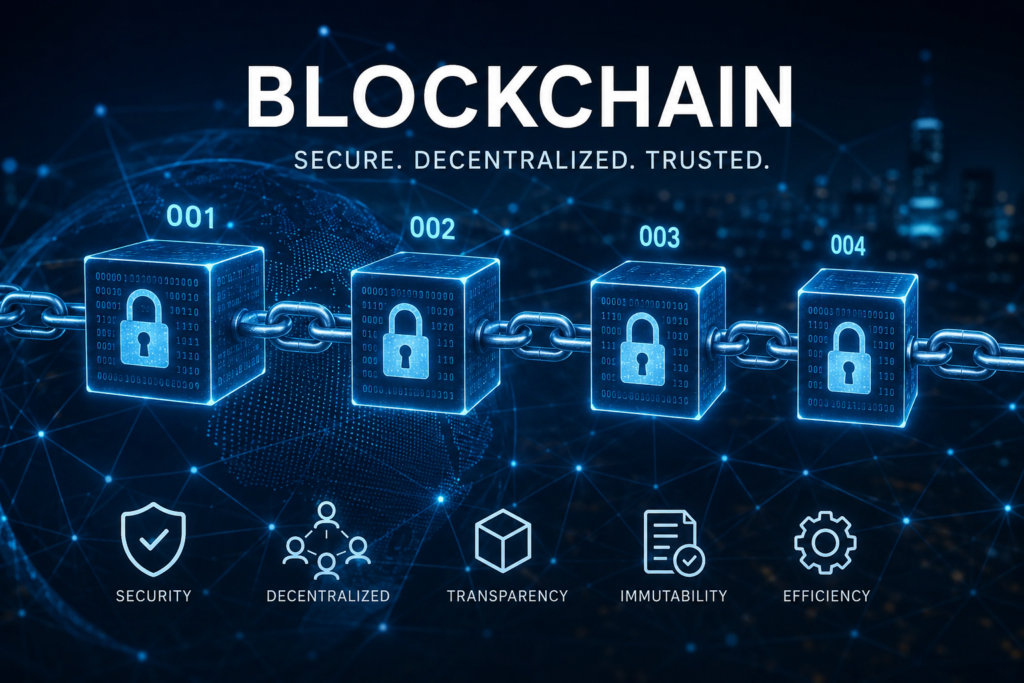
Blockchain is a distributed digital ledger that records transactions across multiple computers. Every transaction is grouped into a block, and each block is securely linked to the previous one, forming a continuous chain. Once information is added, altering or deleting it becomes extremely difficult because every participant in the network holds a copy of the ledger.
Unlike traditional databases controlled by a central organization, this system operates through decentralization. Network participants collectively verify new transactions using predefined consensus mechanisms. As a result, trust is established through technology rather than relying solely on intermediaries.
How Does It Work?
The process begins when a user initiates a transaction. This request is broadcast to the network, where participating computers validate its authenticity. Once verified, the transaction is combined with others into a new block.
The block is then connected to the existing chain using advanced cryptographic techniques. After being added, every copy of the ledger across the network is updated simultaneously. Because each block contains the unique identifier of the previous one, modifying past records would require changing every subsequent block, which is practically impossible in large decentralized networks.
This design creates an environment where records remain accurate, transparent, and resistant to unauthorized changes.
Key Features
Several characteristics make this technology unique compared to conventional information systems.
Decentralization
Instead of storing data on a single server, information is distributed across numerous devices. This reduces the risk of a single point of failure and improves overall reliability.
Transparency
Every approved transaction becomes visible to authorized participants. This level of openness increases accountability and builds trust among users.
Security
Advanced encryption techniques protect stored information. Because records are linked together through cryptographic hashes, unauthorized modifications are extremely difficult.
Immutability
Once a transaction has been confirmed and added to the ledger, it cannot easily be changed. This feature ensures the integrity of historical records.
Efficiency
By eliminating unnecessary intermediaries, many business processes become faster and more cost-effective.
Real-World Applications
Although many people associate this innovation with digital currencies, its practical uses extend far beyond finance.
Financial Services
Banks and payment providers use distributed ledger technology to speed up international transfers, reduce transaction costs, and minimize fraud. Settlement times that once required several days can often be reduced significantly.
Supply Chain Management
Manufacturers and retailers use digital ledgers to monitor products from production to delivery. Every stage of the supply chain can be recorded, allowing companies to verify product authenticity and improve inventory management.
Healthcare
Medical organizations can securely manage patient records while giving authorized professionals controlled access to important information. This improves coordination between hospitals and reduces administrative errors.
Real Estate
Property ownership records can be securely maintained using decentralized systems. Buyers and sellers benefit from increased transparency while reducing paperwork and processing delays.
Education
Educational institutions may issue digital certificates that employers can verify instantly. This reduces the risk of fake diplomas and simplifies credential verification.
Government Services
Governments are exploring secure digital identity systems, voting platforms, and public record management to improve efficiency while reducing fraud and corruption.
Advantages
The growing popularity of this technology is largely due to its numerous benefits.
One major advantage is increased security. Since every transaction undergoes verification before being added to the ledger, fraudulent activities become more difficult.
Transparency also improves trust between organizations and customers. Participants can independently verify records without depending entirely on a central authority.
Cost reduction is another important benefit. Removing intermediaries often lowers transaction fees and administrative expenses.
Automation through smart contracts further enhances efficiency. These self-executing agreements automatically perform actions once predefined conditions are met, reducing manual intervention.
Additionally, global accessibility allows participants from different countries to collaborate using the same secure infrastructure.
Challenges and Limitations
Despite its impressive capabilities, blockchain technology still faces several obstacles.
Scalability remains one of the biggest challenges. Some public networks process fewer transactions per second compared to traditional payment systems.
Energy consumption has also received criticism, particularly for networks that rely on energy-intensive consensus mechanisms. Fortunately, many modern platforms are adopting more efficient alternatives.
Regulatory uncertainty continues to affect adoption. Governments around the world are developing policies to address taxation, compliance, privacy, and digital asset regulation.
Integration with existing business systems can also be expensive and technically complex. Organizations often need specialized expertise to implement new solutions successfully.
Finally, public understanding remains limited. Many people still associate decentralized technology exclusively with cryptocurrency, overlooking its broader business potential.
Beyond Cryptocurrency
While cryptocurrencies introduced this innovation to the world, they represent only one application among many.
Businesses increasingly use distributed ledgers for identity management, document authentication, insurance claims, digital rights management, and secure data sharing. These solutions improve operational efficiency while reducing the need for third-party verification.
Large enterprises are investing heavily in research and pilot projects to discover new commercial opportunities. As adoption grows, decentralized platforms may become an essential component of modern digital infrastructure.
The Future of Blockchain
Experts believe this technology will continue evolving over the coming years. Improvements in scalability, interoperability, and energy efficiency are expected to make decentralized systems more practical for mainstream use.
Artificial intelligence, cloud computing, and the Internet of Things may increasingly integrate with distributed ledgers to create intelligent, automated ecosystems. Smart cities, connected supply chains, and digital healthcare platforms could all benefit from these advancements.
As businesses gain experience with implementation, the technology is likely to move beyond experimentation into large-scale deployment across multiple industries.
Although challenges remain, continuous innovation suggests a promising future.
Conclusion
Blockchain has become far more than the technology behind cryptocurrencies. Its decentralized architecture provides a secure, transparent, and reliable way to store and exchange digital information without relying entirely on centralized authorities.
From banking and healthcare to education and government services, organizations are discovering new ways to improve efficiency, reduce costs, and strengthen trust through distributed ledger technology.
As research continues and adoption expands, this innovation has the potential to reshape digital interactions on a global scale. Businesses that understand its capabilities today will be better prepared to benefit from the opportunities of tomorrow.
more in: tocentimes