
























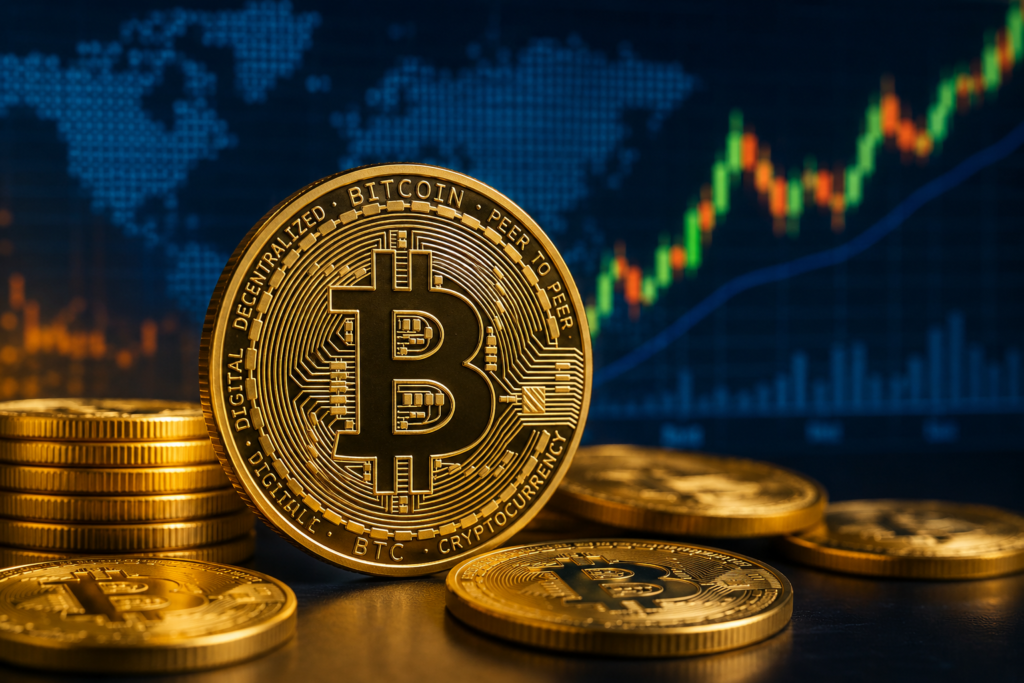
Bitcoin: The Future of Digital Money
Introduction
Bitcoin has transformed the financial world since its introduction in 2009. As the first decentralized cryptocurrency, it has changed how people think about money, payments, and investments. Unlike traditional currencies issued by governments, operates on a peer-to-peer network without requiring banks or financial institutions. Today, Bitcoin is recognized as both a digital currency and a valuable investment asset, attracting millions of users worldwide.
In this article, we will explore what is, how it works, its advantages and disadvantages, its impact on the global economy, and what the future may hold for this revolutionary technology.
What Is Bitcoin?
Bitcoin is a decentralized digital currency that allows people to send and receive money over the internet without relying on a central authority. It was created by an anonymous individual or group using the pseudonym Satoshi Nakamoto.
Unlike fiat currencies such as the US Dollar or Euro, exists only in digital form. Every transaction is recorded on a public ledger known as the blockchain, ensuring transparency and security.
Bitcoin has a limited supply of 21 million coins, making it a scarce digital asset. This scarcity has contributed significantly to its popularity as a store of value, often earning it the nickname “digital gold.”
How Does Bitcoin Work?
Bitcoin operates using blockchain technology. A blockchain is a distributed ledger that records every transaction ever made on the network.
Here’s how a transaction works:
- A user initiates a transaction.
- The transaction is broadcast to the network.
- Miners verify the transaction using powerful computers.
- Once verified, the transaction is added to a new block.
- The block is permanently linked to the existing blockchain.
This decentralized system eliminates the need for banks while maintaining a high level of security through cryptographic verification.
Bitcoin Mining
Mining is the process of validating Bitcoin transactions and adding them to the blockchain.
Miners compete to solve complex mathematical puzzles. The first miner to solve the puzzle earns the right to add the next block and receives newly created Bitcoins as a reward.
Mining serves two essential purposes:
- It secures the network.
- It introduces new Bitcoins into circulation.
However, mining requires specialized hardware and consumes a significant amount of electricity, leading to ongoing debates about its environmental impact.
Why Is Bitcoin Valuable?
Many people wonder why has value despite existing only digitally.
Several factors contribute to Bitcoin’s value:
Limited Supply
Only 21 million Bitcoins will ever exist. This scarcity makes resistant to inflation compared to traditional currencies that governments can print without limit.
Decentralization
No government, company, or central bank controls. This independence appeals to people seeking financial freedom.
Security
Bitcoin uses advanced cryptography and blockchain technology, making it extremely difficult to counterfeit or manipulate.
Global Accessibility
Anyone with an internet connection can access, making it particularly valuable in regions with unstable financial systems.
Growing Adoption
More businesses, financial institutions, and investors continue to adopt Bitcoin, increasing its legitimacy and demand.
Advantages of Bitcoin
offers numerous benefits that have contributed to its rapid adoption.
Financial Independence
Users have complete control over their funds without depending on banks or intermediaries.
Fast International Payments
Cross-border Bitcoin transactions can often be completed much faster than traditional bank transfers.
Lower Transaction Fees
In many cases, Bitcoin transactions cost less than international banking services.
Transparency
Every Bitcoin transaction is publicly recorded on the blockchain, reducing fraud and increasing trust.
Inflation Protection
Because has a fixed supply, many investors view it as a hedge against inflation.
Disadvantages of Bitcoin
Despite its many strengths, also faces several challenges.
Price Volatility
Bitcoin’s price can rise or fall dramatically within a short period, making it a risky investment.
Regulatory Uncertainty
Governments around the world continue developing regulations regarding cryptocurrency use and taxation.
Energy Consumption
Bitcoin mining consumes substantial amounts of electricity, raising environmental concerns.
Limited Everyday Use
Although adoption is increasing, is still not accepted everywhere as a payment method.
Security Risks
While the Bitcoin network itself is highly secure, users may lose access to their funds if they lose their private keys or fall victim to scams.
Bitcoin as an Investment
has become one of the most popular investment assets of the 21st century.
Some investors buy Bitcoin as a long-term store of value, believing its scarcity will drive prices higher over time. Others actively trade to profit from its price fluctuations.
Institutional investors, hedge funds, and publicly traded companies have also entered the market, increasing its credibility.
However, investing in Bitcoin carries risks due to its volatility. Investors should conduct thorough research and only invest money they can afford to lose.
Bitcoin vs Traditional Currency
differs significantly from traditional money.
| Bitcoin | Traditional Currency |
|---|---|
| Decentralized | Controlled by central banks |
| Limited supply | Unlimited printing possible |
| Digital only | Physical and digital |
| Global access | Country-specific |
| Blockchain transactions | Bank-mediated transactions |
These differences explain why Bitcoin has attracted both supporters and critics.
Bitcoin and Blockchain Technology
Although introduced blockchain technology, blockchain has applications beyond cryptocurrency.
Industries using blockchain include:
- Supply chain management
- Healthcare
- Banking
- Real estate
- Voting systems
- Digital identity verification
demonstrated the potential of decentralized technology, inspiring thousands of blockchain projects worldwide.
The Future of Bitcoin
Experts remain divided about Bitcoin’s future.
Some believe Bitcoin could become a global reserve asset similar to gold.
Others expect governments to regulate cryptocurrencies more heavily while central bank digital currencies (CBDCs) become more common.
Several trends may shape Bitcoin’s future:
- Increased institutional adoption
- Improved scalability through Layer-2 technologies
- Greater regulatory clarity
- Growing use in developing countries
- Continued innovation in blockchain infrastructure
Despite uncertainty, continues to play a major role in the evolution of digital finance.
Is Bitcoin Safe?
itself is considered one of the most secure digital networks ever created.
Its blockchain has never been hacked at the protocol level. However, users remain responsible for protecting their wallets and private keys.
To improve security, owners should:
- Use hardware wallets for long-term storage.
- Enable two-factor authentication.
- Avoid phishing scams.
- Store recovery phrases securely.
- Purchase only through reputable exchanges.
Practicing good security habits significantly reduces the risk of losing digital assets.
Conclusion
Bitcoin has revolutionized the concept of money by introducing a decentralized financial system powered by blockchain technology. With its limited supply, strong security, and growing global adoption, continues to influence the future of finance.
Although it faces challenges such as price volatility, regulatory uncertainty, and environmental concerns, remains one of the most important technological innovations of the digital age.
Whether viewed as digital money, a long-term investment, or a groundbreaking technological achievement, has already secured its place in financial history. As adoption continues to grow and blockchain technology evolves, will likely remain at the center of discussions about the future of the global economy.
MORE IN: TOKEN TIMES