
























the World’s Largest Financial Market: A Complete Beginner’s Guide
Introduction
Every day, trillions of dollars move across international financial markets, creating opportunities for investors, businesses, and governments alike. Among these markets, the global currency exchange market stands out as the largest and most liquid financial marketplace in existence. Unlike stock exchanges that operate during specific hours, this market functions nearly 24 hours a day, allowing participants from around the world to buy and sell currencies continuously.
The popularity of Forex trading has grown significantly over the past decade. Advances in technology have made it easier than ever for retail traders to access professional trading platforms, analyze market data, and execute trades from virtually anywhere. While the opportunities are substantial, success requires knowledge, discipline, and a strong understanding of market dynamics.
This guide explores how the currency market works, what influences price movements, the benefits and risks involved, and practical strategies that beginners can use to build a solid foundation.
How the Currency Exchange Market Works
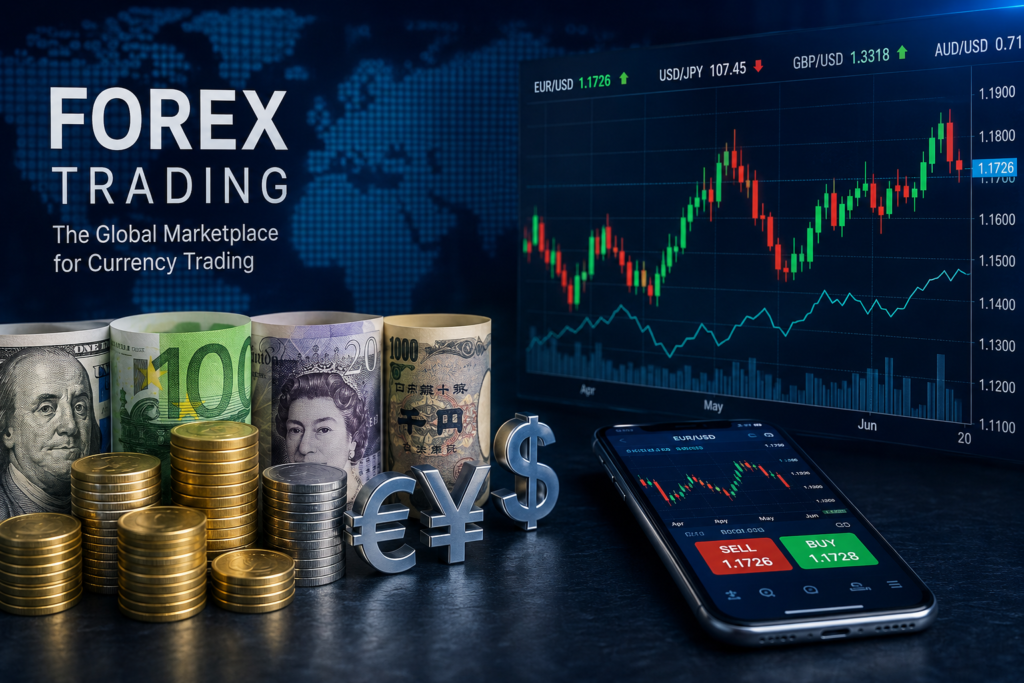
Currencies are always traded in pairs because one currency is exchanged for another. For example, when trading EUR/USD, a trader is simultaneously buying euros while selling U.S. dollars.
The first currency in a pair is called the base currency, while the second is known as the quote currency. The displayed price tells traders how much of the quote currency is required to purchase one unit of the base currency.
Unlike traditional stock exchanges, this market is decentralized. Transactions occur electronically through a network of banks, brokers, financial institutions, hedge funds, corporations, and individual traders. This decentralized structure contributes to exceptional liquidity and relatively low transaction costs.
Because the market operates across major financial centers such as London, New York, Tokyo, and Sydney, trading continues almost around the clock from Monday through Friday.
Why So Many People Choose This Market
One of the biggest attractions is accessibility. Many brokers allow individuals to open accounts with relatively small deposits, making participation possible for beginners.
Another advantage is high liquidity. Since enormous trading volumes occur every day, buyers and sellers are usually available, reducing delays in executing trades.
Many traders also appreciate the ability to profit from both rising and falling prices. Unlike some investment markets where gains mainly come from price increases, currency traders can potentially benefit when exchange rates move in either direction.
Leverage is another appealing feature. It allows traders to control larger positions with a smaller amount of capital. While leverage can amplify profits, it can also magnify losses, making risk management absolutely essential.
The Main Participants
The global currency market includes a wide variety of participants, each serving different purposes.
Central banks influence exchange rates through monetary policy, interest rate decisions, and market interventions.
Commercial banks facilitate international transactions and provide liquidity.
Multinational corporations exchange currencies to conduct international business, pay suppliers, and manage overseas operations.
Investment funds trade currencies as part of diversified portfolios or speculative strategies.
Retail traders participate through online brokers, attempting to profit from short-term or long-term market movements.
Each participant contributes to the enormous daily trading volume that keeps the market active and efficient.
Factors That Drive Price Movements
Exchange rates rarely move randomly. Instead, they respond to numerous economic and political developments.
Interest rates play a major role. Higher interest rates often attract foreign investment because investors seek better returns, increasing demand for a country’s currency.
Inflation also affects currency values. Lower inflation generally supports stronger currencies because purchasing power remains relatively stable.
Employment reports frequently create volatility. Strong labor market data can signal economic growth, while disappointing figures may weaken investor confidence.
Gross Domestic Product (GDP) provides insight into economic performance. Faster economic expansion often strengthens national currencies.
Political stability matters as well. Elections, geopolitical tensions, government policies, and international conflicts can all influence investor sentiment.
Unexpected global events such as pandemics, natural disasters, or financial crises may trigger rapid changes in exchange rates.
Popular Trading Approaches
There is no single strategy that guarantees success. Instead, traders choose approaches that match their personalities, schedules, and risk tolerance.
Day trading involves opening and closing positions within a single trading session, avoiding overnight exposure.
Swing trading focuses on capturing price movements over several days or weeks.
Scalping seeks to profit from numerous small price changes throughout the day.
Position trading takes a long-term perspective based on broader economic trends.
Each method requires different levels of commitment, analysis, and emotional discipline.
Understanding Market Analysis
Successful traders often combine multiple forms of analysis before entering a position.
Technical analysis examines historical price charts, trends, support and resistance levels, and indicators such as moving averages or the Relative Strength Index (RSI).
Fundamental analysis evaluates economic reports, inflation data, interest rate announcements, and central bank policies.
Sentiment analysis attempts to understand the overall mood of market participants by observing positioning, news events, and investor behavior.
Combining these methods often provides a more balanced trading perspective.
Common Mistakes Beginners Make
Many new traders enter the Forex market expecting instant wealth. Unfortunately, unrealistic expectations often lead to poor decisions.
One frequent mistake is overtrading. Opening too many positions increases emotional stress and transaction costs.
Ignoring stop-loss orders exposes traders to potentially devastating losses.
Another common error is risking too much capital on a single trade. Professional traders often risk only a small percentage of their account on each position.
Revenge trading—trying to recover losses immediately—usually results in even larger losses.
Finally, many beginners neglect education, relying on social media tips instead of developing their own understanding.
official forex site: FOREX site
Building Strong Risk Management Habits
Risk management is often more important than finding perfect trade entries.
Successful traders define their maximum acceptable loss before opening any position.
Diversification can reduce overall exposure by avoiding excessive concentration in similar currency pairs.
Maintaining realistic profit expectations helps reduce emotional decision-making.
Keeping a trading journal allows traders to review mistakes, identify patterns, and improve performance over time.
Using leverage conservatively protects trading capital during periods of unexpected market volatility.
Patience is often one of the most valuable trading skills.
Technology’s Growing Influence
Modern trading has evolved significantly thanks to technological innovation.
Advanced charting software enables traders to perform sophisticated market analysis within seconds.
Economic calendars provide real-time updates on important financial announcements.
Mobile trading applications allow users to monitor positions while traveling.
Artificial intelligence and machine learning are increasingly used to identify trading opportunities, analyze historical data, and automate certain strategies.
Despite these technological improvements, human judgment remains essential for managing uncertainty and adapting to changing market conditions.
Is It Suitable for Everyone?
Although the market offers exciting opportunities, it is not appropriate for every investor.
Individuals with limited financial resources or low tolerance for risk should approach cautiously.
Anyone considering participation should first build an emergency savings fund and avoid trading with money needed for essential expenses.
Education, practice accounts, and gradual experience are far more valuable than rushing into live trading.
Developing consistent habits takes time, and even experienced professionals continue learning throughout their careers.
Conclusion
Forex remains one of the most dynamic financial markets in the world, attracting participants from nearly every country. Its accessibility, liquidity, and continuous operation make it appealing to both beginners and experienced investors. However, long-term success depends less on luck and more on education, discipline, effective risk management, and continuous improvement.
Rather than chasing quick profits, aspiring traders should focus on understanding market behavior, developing a tested strategy, and managing risk responsibly. With patience and a commitment to learning, individuals can gradually build the knowledge and confidence needed to navigate the complexities of Forex trading while avoiding many of the mistakes that challenge new participants.
more in: token times